

Sailing the Windwards & Photos
Below is my latest Aurora Update, sent out on June 2nd. However, I see that Ken added two posts to the blog since my update went out, so this posting is out of sequence and repetitive. Nevertheless, we see the world differently so reading my blog may provide you with a different take on our travels. And I have included a few pictures. To see more photos, check out our web site at svaurora.com/newsite
June 2, 2007
We are anchored in the Cul-de-Sac du Marin on the south side of Martinique, the northern-most of the Windward Islands. We arrived this afternoon after a rough and tumble sail from St Pierre, a town on the west side of Martinique. We sailed through a squall and experienced our first 40 knot winds! Exciting, but we've sailed enough to be familiar with how to manage the boat. The jib had already been pulled in and the main sail was reefed, as it should be. The wind was blowing hard, but Aurora is a blue water vessel and it was not too much for her.
Although we managed the 40-knot winds well, it was our fist squall and a bit intimidating. And that was not it for sailing excitement today. When we were making our way into the harbor and were ready to roll up the main, it didn't roll. We have in-mast roller furling on the main, which requires a motor to turn the furler and roll up the sail. The motor that turns the furler didn't work! No fun, especially on a day with the winds blowing hard. Ken had to hand crank in the main using the winch handle while I steered the boat into the wind and managed the outhaul line. Not only did I have to keep Aurora facing into the wind, which was blowing 25 knots and pushing her all over the place, but I also had to steer clear of oncoming boat traffic, random fish traps, the occasional fishing skiff as well as stay off the shoals. To make it more challenging, I had to do this while keeping the right amount of tension on the outhaul line. Well I can't say I did a perfect job. The boat kept moving away from the wind and the outhaul tension was never tight or loose enough, but we did get the sail in. Ken's task wasn't any easier as the halyard cleats had been attached to the mast just forward of the slot for the manual furling handle. This meant he could not make a 360 degree turn with the handle and wind the sail in, but had to turn it approximately 250 degrees, take the handle out reinsert and turn again. He got the job done, but not without a few choice words directed at the person who attached the halyard cleats to the mast! Not to mention the words directed my way when Aurora was not going into the wind or the tension on the outhaul was too tight or loose! The good news is that we eventually got the main sail furled and made it to the anchorage.
After sailing though the squall and getting the sail in, we were ready to find a nice spot to anchor and be done for the day. Not as easy as it sounds. The anchorage was very crowded and the wind was still blowing. There were just no obvious spots to anchor. We motored around looking for a good place, akin to finding a parking space at the mall during Christmas shopping season. Getting Aurora anchored didn't go too well. What normally is a routine task for us, took us three tries at three different locations to succeed. But we finally got her anchored as we wanted, not too close to any other boats and the anchor set so she would't drag. Nice to be done for the day.
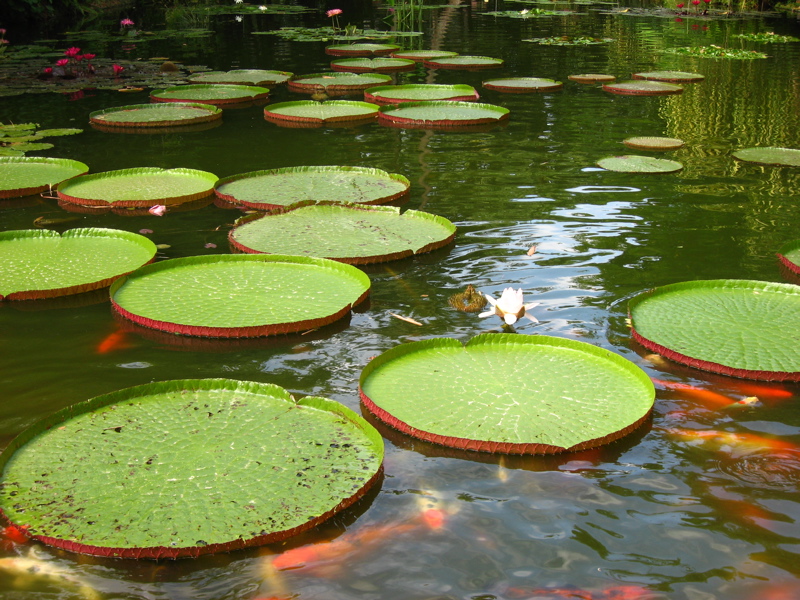
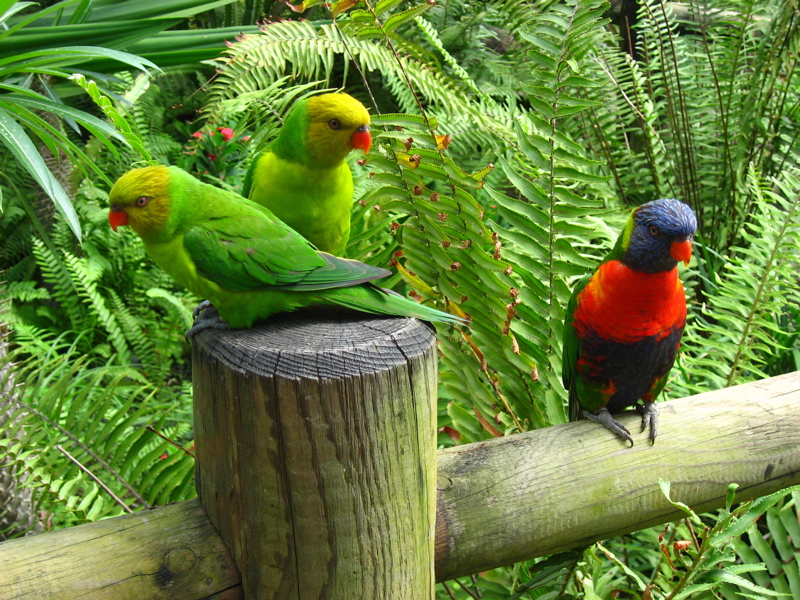
That was today, but we've had some wonderful experiences since my last update where we had arrived in Deshaies (Day hay), Guadeloupe. In Deshaies, we had the best croissants ever – fresh baked, melt-in-your-mouth buttery and flaky. Not sure what made these particular croissants so good, but something did. Guadeloupe is a French island and like France has boulangeries as well as little deli's where one can get sandwiches and baked goods and always the baguette. After breakfast we walked to a botanical garden that had been mentioned in our guide book. I didn't expect much as the town was small and the previous gardens we'd seen were nice, but not amazing. However, we were surprised to find ourselves in one of the most beautiful gardens I'd ever seen. The plants were healthy, blooming and well tended. The trees were large, providing much needed shade. All of the plants were labeled in French, but we could figure out many of the labels. And the garden walk was constructed so that one wandered through the trees and flowers in such a way as to see them at their best as well as providing beautiful views of the open spaces on the grounds. In addition to plants there were loris, lorikeets, parrots and flamingos. The loris were so tame they would sit on your shoulders if they thought you were going to feed them. Ken pushed the lever on the food dispenser and one of the birds landed on his shoulder. The birds were fun, but the plants were amazing - the trees huge, the flowers lush and the grounds lovely. There was even a pool with koi and large water lilies.
We only spent one day at Deshaies. From there we headed south along the coast of Guadeloupe. Our destination was Basse Terre, the second largest city on the island and its capital, but as we got close it didn't look inviting. The Iles des Saintes were only 5 miles off Guadeloupe's southern coast and, from what we read in our guide book, much more appealing. So we just kept sailing. I'm glad we did. Iles des Saintes (The Saints) were a charming set of islands. In fact, they are part of Guadeloupe and are a favorite vacation spot for folks from the big island. Like all of the French islands we've visited to date, they are just like being in France. French is spoken, all signs, information and text is in French and they look and feel like little French towns, which they are. Baguettes are 0.80 Euros, just like in France. (It's true, I've never been to France. But this is what I understand from people I talk with and it makes sense to me.)
Terre den Haut, the main island of The Saints, is home to the only town on The Saints, Bourg des Saintes. Terre den Haut is so small that one can walk the entire island easily. The beaches are all accessible by foot. The inhabitants drive scooters, not cars. It was not unusual to see an older woman, say in her 70's, riding around town on a scooter. Bourg des Saintes had several shops that carried locally made clothing and crafts. At Maogany West-Indigo, a small boutique, I purchased a sea washed indigo top. The owner designed, dyed and painted all of the clothes in his shop himself. He does quality work.
From The Saints we sailed on to Dominica where we spent a night anchored in Prince Rupert Bay off the town of Portsmouth. What a change. Dominica has eight volcanoes on the island. The beaches are narrow and made of black sand. The island is mountainous and the mountains are home to rain forests and several beautiful waterfalls. Dominica is an English-speaking island with a mixed cultural heritage influenced by Britain, France and Africa . On Dominica boat guides come out to meet you as you sail in. They provide services for boaters. Albert met us on our way in to Prince Rupert Bay. He welcomed us to Dominica and guided us to a safe anchorage. We arranged with Albert to tour the Indian River. He met us the next morning and took us up the river, which wanders through some beautiful swamps and amazing flora and fauna. I kind of felt like I was on the jungle ride at Disneyland! We saw iguanas in the trees, crabs hiding along the river's edge, schools of fish swimming next to the boat and birds in and above the trees. Animal and insect sounds filled the air. The river was alive with bird, frog and insect noises. When I closed my eyes, I could have been listening to one of those "Sounds of Nature" CDs. ; -)
A few of the "Pirates of the Caribbean" sequel scenes were shot along the Indian River. It had that creepy, pirate feel to it. Not surprising to hear it was used in the movies.
We did get into town, Portsmouth, the next morning to clear in and out of customs. It was not a beautiful town, like Bourg des Saintes. The people were poor, the buildings in need of repair and the ground littered. The main street was torn up due to the construction of sidewalks. Felt like this project had been going on a long time. Not a tourist destination. Having said that, I found a beautiful hand-made Carib basket in one of the shops. It was just what I have been looking for and was pleased to have found it. Our fruit now lives in the new basket above the starboard settee in the saloon. Ken is happy to have the old fruit basket out of the galley and out of his way.
From Portsmouth we headed to Roseau, the capital of Dominica. This time, Roots, a boat guide, met us in the anchorage/mooring field. However, Albert, our guide in Portsmouth, had referred us to Pancho. Pancho showed up after we had hooked up to a mooring to say hello and offer his services. Now we had two boat guides who wanted our business. What to do? Well, the problem solved itself. Pancho got our business when we could not locate Roots to provide us with a ride to town. Pancho was available, so we had him take us. On the way back from town, we made arrangements with Pancho to tour the waterfalls the next morning. He turned out to be an entertaining as well as informative guide. He pointed out all sorts of plants as we drove to the falls, going so far as to stop the car and pick leaves or pods. He gave us some pods from a plant located just off the road, and asked us to identify them. We couldn't. It turned out to be coffee pods with beans inside.
The falls were beautiful. Set in the Dominica rainforest, they cascaded down into pools of cool water. Pancho and I went swimming. Felt good as the day was hot and humid. Pancho also took us to a small "boiling" lake, which was actually a vent for volcanic activity in the form of a small pool of boiling water. There is on the island a true lake of boiling water, 60 meters in width, but to see it required an all day commitment and we knew the weather was turning and we wanted to get to Martinique. Not surprising, Roots was not a happy camper that we had gone on a tour with Pancho. Appears that this was not unusual. We read in another cruising couple's journal that both Roots and Pancho were vying for their business as well. This is their livelihood. There's not a lot of opportunities on these islands for young men raising families. Both Roots and Pancho had young sons they were quite proud of. It seems they could find a way to deal with the issue of who meets and takes care of which boats.
I have found the Caribbean's to be a proud people who love their islands. Many times we'd meet a cab driver or a tour guide or a shop keeper and they'd tell us how beautiful their island is and how much the love it. They wouldn't want to live anywhere else. Life is not always easy for islanders. Their homes are simple, their world not filled with conveniences, jobs not abundant yet they are proud of their islands, their families and their work. Simple pleasures are enjoyed. Family members are included. At a bakery in Portsmouth the 96-year-old mom of the woman who ran the shop was sitting in the bakery. We chatted and it became clear that the daughter was proud of her mother's age and that Dominica had many centenarians living on the island. Roots had his young son on his boat with him and mentioned that he was in school. It was important to him. Our Taxi driver on St Kitts stopped off at home to drop off a package to this daughter and introduced us to her. He was quite delighted with his daughter and her friendly, outgoing manner. Of course this is an over statement, but it captures my impression of life on these islands. In contrast, we Americans have so much and yet as a society of people we appear to be discontent.
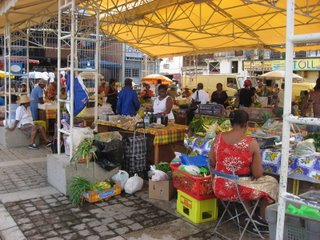
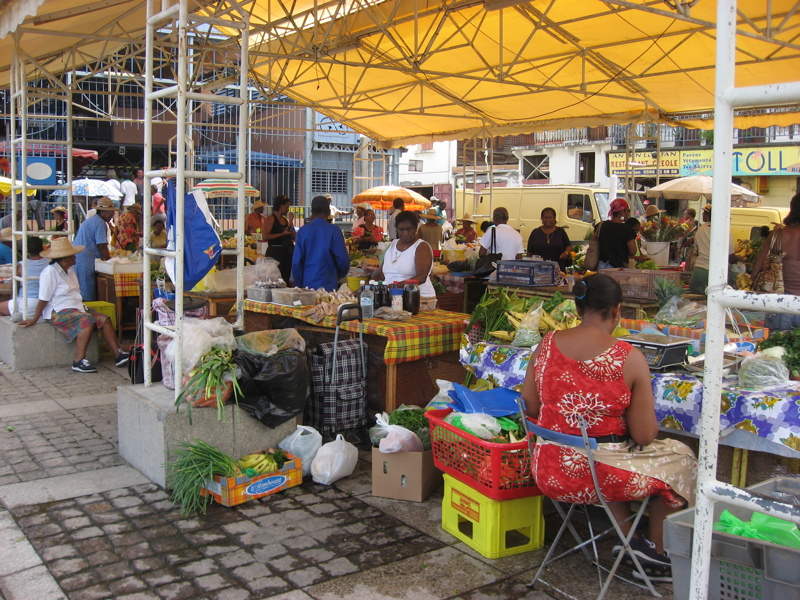
From Dominica we sailed to Martinique and anchored in the harbor off of St Pierre. Again the wind was on the nose and we saw 30 knots. However, the seas were not too high, so the passage was not as rough. We spent only one night in St Pierre. We didn't see much of the town and none of the island. We did try their pizza. It was just barely edible, the sauce bland, the olives still contained pits and the cheese not melted. However, we were hungry and our reefer was nearly empty, containing only condiments and beer. So we ate the pizza. This morning, before we set sail, we stopped in the open-air market to purchase fresh vegetables and fruit. So nice. Located at the end of the dock, it was easy for us to get to and was very much like a farmers' market at home. I'll need to soak all of the produce in a bleach solution before we eat it, but it should be fine. I purchased lettuce, tomatoes, cucumbers, a pineapple, limes and bananas. As I speak no French, pointing and hand gestures were my communication tools. Ken speaks a little French and was able to manage the payment.
Today we sailed. It was our roughest day of sailing so far. I wrote about it in the first paragraph of this update. That brings me up to date. We'll probably be in Marin for a few days. The weather needs to calm down and we (Ken with my assistance at running and fetching tools and towels) need to fix the main sail furler as well as the aft head switch. Oh yes, the switch finally arrived. We had it sent to St Maarten, but the supplier sent it USPS Priority Mail (US mail) when I had requested overnight delivery. US mail takes a while, even priority mail. We left St Maarten without the part. Thus we had to wait for the part to arrive in St Maartin, then call them to forward it on to Roseau, Dominica. And pay again for shipping and postage. However, the folks at St Maartin sent it FedEx. We were able to pick it up in Roseau. We now have the part. Ken just needs to install it, with my assistance. =^) Then hopefully the aft head will work again.
As a cruiser we met in Portsmouth said, living on a boat is a fix and repair daily lifestyle. So true. Something breaks or stops working on a daily basis. Neither Ken nor I anticipated the amount of stuff that would break, nor how often it would break. At times it is daunting. However, from our conversations with other boaters, this is normal. Things break all the time on a boat. It is part of the life.
That's it for this update. I've attached a few pictures. I'll put an album on our website with many more. Website URL: svAurora.com/newsite. Check out the "Photo Gallery" for the latest photos. But give me a day or two. They're not up yet!
Safe Passages,
Maryann
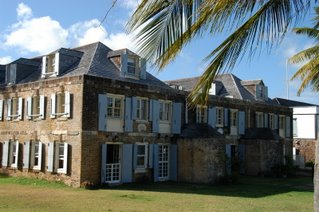
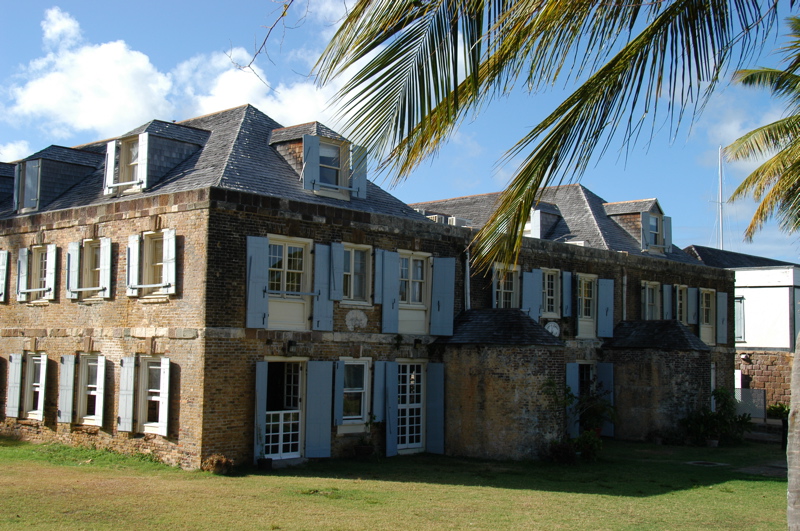
English Harbor, Antigua. These are some of the original buildings from Nelson's Dockyard dating from the mid 1700's.
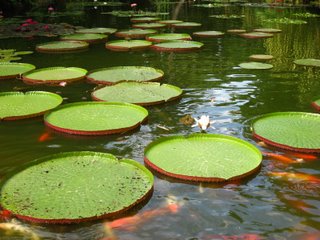
Water lilies at the botanical garden in Deshaies, Guadeloupe. The koi were feeding. You can see them at the bottom of the photo.
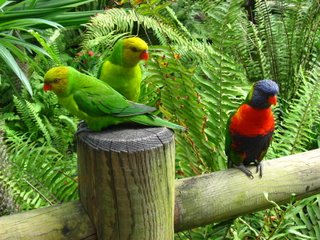
Loris and lorikeets at the Deshaies botanical garden, Guadeloupe.
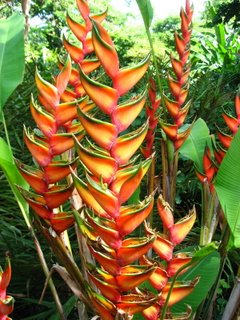
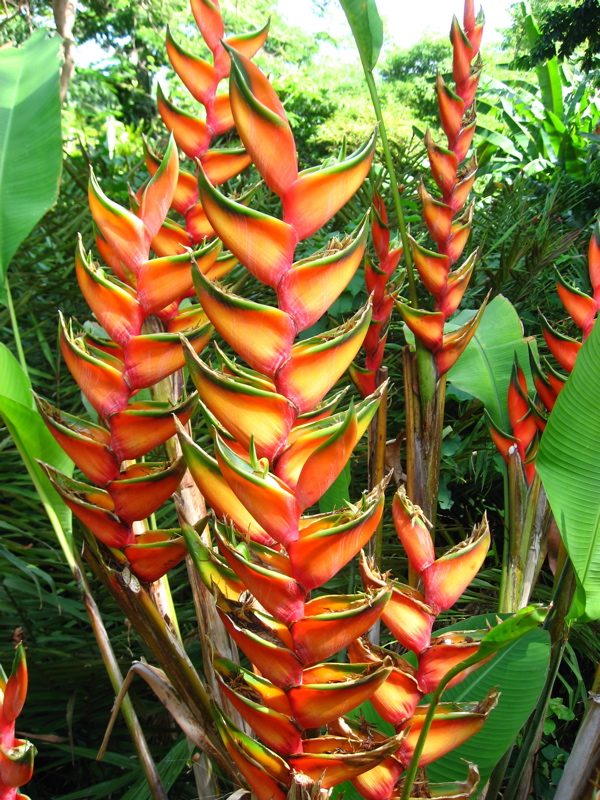
Tropical flowers. Botanical garden, Deshaies, Guadeloupe.
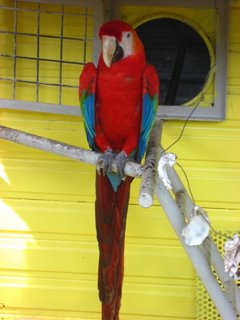
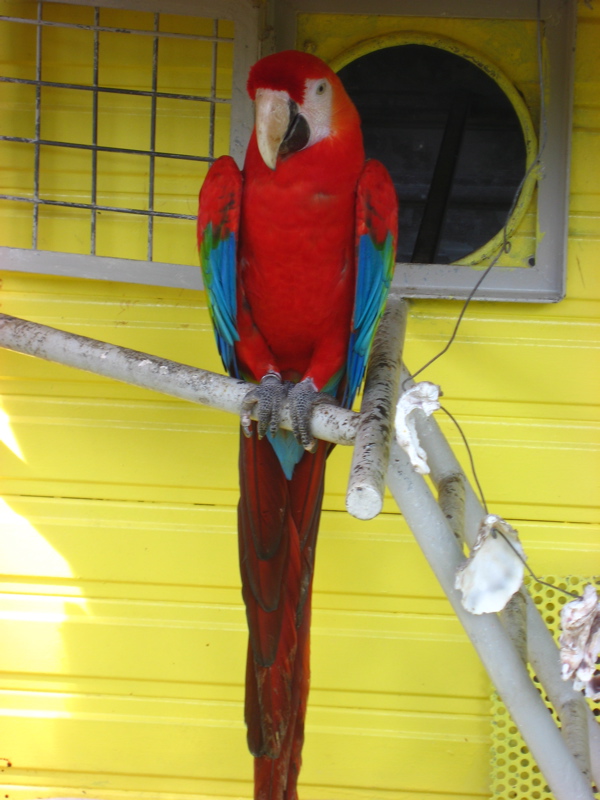
One of several parrots at the botanical garden. Each had their own bird house, which was brightly painted and each house a different color.
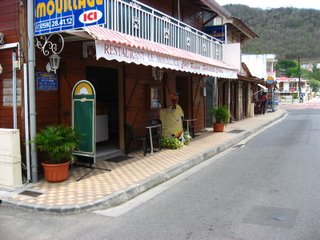
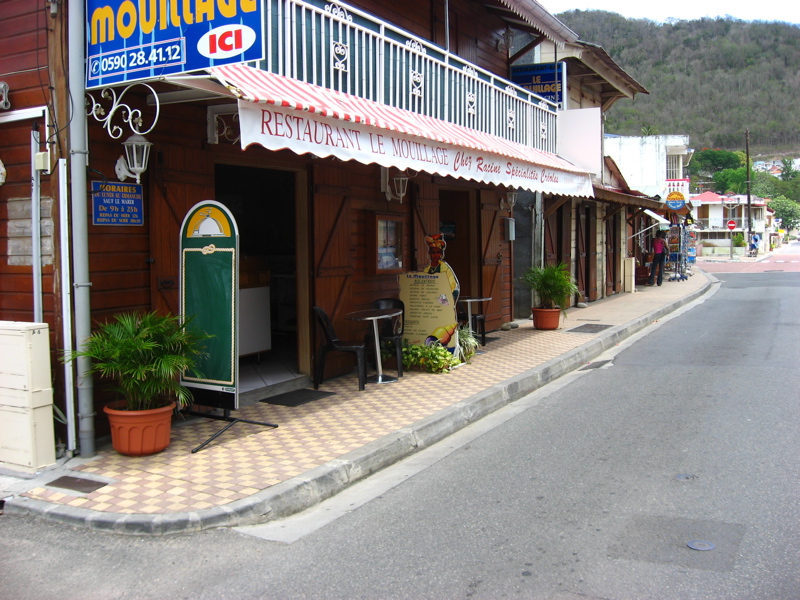
This was the main street in Deshaies. Across the street from the Restaurant Le Mouillage was the bakery with the best-ever croissants.
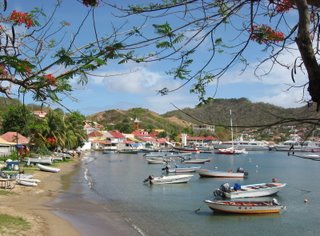
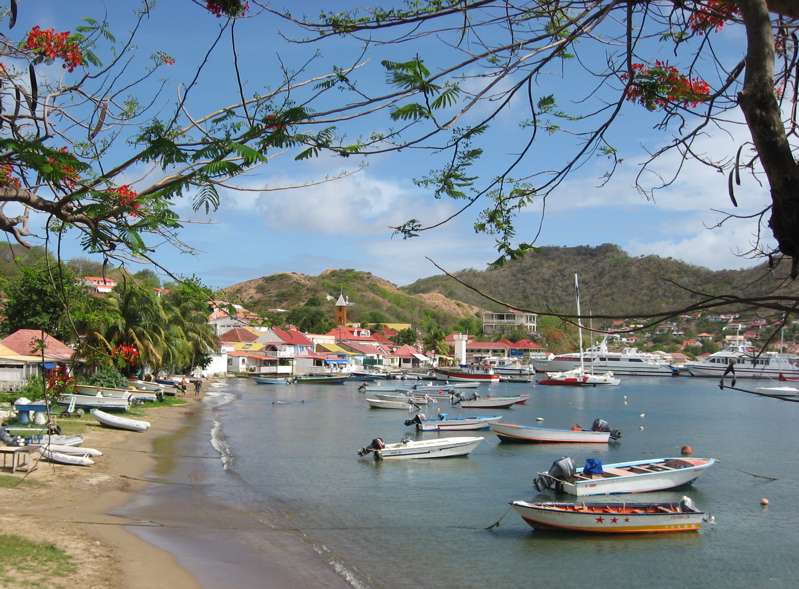
The harbor at Bourg des Saintes on the island of Terre den Haut in Iles des Saintes, Guadeloupe. A delightful town.
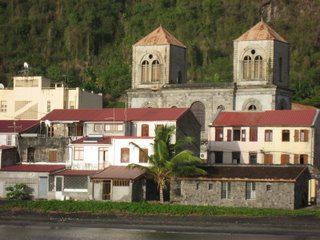
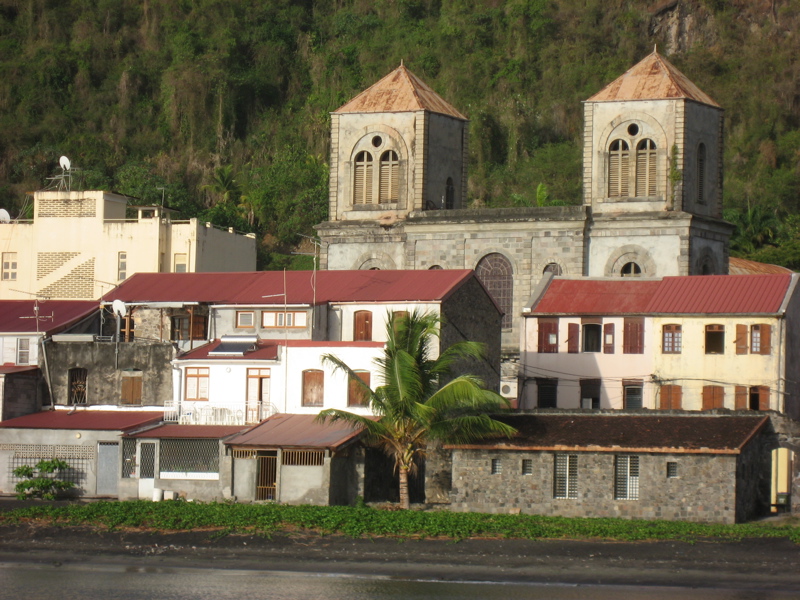
In every French town the church bells ring on the hour. These were the towers of the church in St. Pierre, Martinique.
The market in St Pierre, Martinique. I purchased fruits and vegetables here.
June 2, 2007
We are anchored in the Cul-de-Sac du Marin on the south side of Martinique, the northern-most of the Windward Islands. We arrived this afternoon after a rough and tumble sail from St Pierre, a town on the west side of Martinique. We sailed through a squall and experienced our first 40 knot winds! Exciting, but we've sailed enough to be familiar with how to manage the boat. The jib had already been pulled in and the main sail was reefed, as it should be. The wind was blowing hard, but Aurora is a blue water vessel and it was not too much for her.
Although we managed the 40-knot winds well, it was our fist squall and a bit intimidating. And that was not it for sailing excitement today. When we were making our way into the harbor and were ready to roll up the main, it didn't roll. We have in-mast roller furling on the main, which requires a motor to turn the furler and roll up the sail. The motor that turns the furler didn't work! No fun, especially on a day with the winds blowing hard. Ken had to hand crank in the main using the winch handle while I steered the boat into the wind and managed the outhaul line. Not only did I have to keep Aurora facing into the wind, which was blowing 25 knots and pushing her all over the place, but I also had to steer clear of oncoming boat traffic, random fish traps, the occasional fishing skiff as well as stay off the shoals. To make it more challenging, I had to do this while keeping the right amount of tension on the outhaul line. Well I can't say I did a perfect job. The boat kept moving away from the wind and the outhaul tension was never tight or loose enough, but we did get the sail in. Ken's task wasn't any easier as the halyard cleats had been attached to the mast just forward of the slot for the manual furling handle. This meant he could not make a 360 degree turn with the handle and wind the sail in, but had to turn it approximately 250 degrees, take the handle out reinsert and turn again. He got the job done, but not without a few choice words directed at the person who attached the halyard cleats to the mast! Not to mention the words directed my way when Aurora was not going into the wind or the tension on the outhaul was too tight or loose! The good news is that we eventually got the main sail furled and made it to the anchorage.
After sailing though the squall and getting the sail in, we were ready to find a nice spot to anchor and be done for the day. Not as easy as it sounds. The anchorage was very crowded and the wind was still blowing. There were just no obvious spots to anchor. We motored around looking for a good place, akin to finding a parking space at the mall during Christmas shopping season. Getting Aurora anchored didn't go too well. What normally is a routine task for us, took us three tries at three different locations to succeed. But we finally got her anchored as we wanted, not too close to any other boats and the anchor set so she would't drag. Nice to be done for the day.
That was today, but we've had some wonderful experiences since my last update where we had arrived in Deshaies (Day hay), Guadeloupe. In Deshaies, we had the best croissants ever – fresh baked, melt-in-your-mouth buttery and flaky. Not sure what made these particular croissants so good, but something did. Guadeloupe is a French island and like France has boulangeries as well as little deli's where one can get sandwiches and baked goods and always the baguette. After breakfast we walked to a botanical garden that had been mentioned in our guide book. I didn't expect much as the town was small and the previous gardens we'd seen were nice, but not amazing. However, we were surprised to find ourselves in one of the most beautiful gardens I'd ever seen. The plants were healthy, blooming and well tended. The trees were large, providing much needed shade. All of the plants were labeled in French, but we could figure out many of the labels. And the garden walk was constructed so that one wandered through the trees and flowers in such a way as to see them at their best as well as providing beautiful views of the open spaces on the grounds. In addition to plants there were loris, lorikeets, parrots and flamingos. The loris were so tame they would sit on your shoulders if they thought you were going to feed them. Ken pushed the lever on the food dispenser and one of the birds landed on his shoulder. The birds were fun, but the plants were amazing - the trees huge, the flowers lush and the grounds lovely. There was even a pool with koi and large water lilies.
We only spent one day at Deshaies. From there we headed south along the coast of Guadeloupe. Our destination was Basse Terre, the second largest city on the island and its capital, but as we got close it didn't look inviting. The Iles des Saintes were only 5 miles off Guadeloupe's southern coast and, from what we read in our guide book, much more appealing. So we just kept sailing. I'm glad we did. Iles des Saintes (The Saints) were a charming set of islands. In fact, they are part of Guadeloupe and are a favorite vacation spot for folks from the big island. Like all of the French islands we've visited to date, they are just like being in France. French is spoken, all signs, information and text is in French and they look and feel like little French towns, which they are. Baguettes are 0.80 Euros, just like in France. (It's true, I've never been to France. But this is what I understand from people I talk with and it makes sense to me.)
Terre den Haut, the main island of The Saints, is home to the only town on The Saints, Bourg des Saintes. Terre den Haut is so small that one can walk the entire island easily. The beaches are all accessible by foot. The inhabitants drive scooters, not cars. It was not unusual to see an older woman, say in her 70's, riding around town on a scooter. Bourg des Saintes had several shops that carried locally made clothing and crafts. At Maogany West-Indigo, a small boutique, I purchased a sea washed indigo top. The owner designed, dyed and painted all of the clothes in his shop himself. He does quality work.
From The Saints we sailed on to Dominica where we spent a night anchored in Prince Rupert Bay off the town of Portsmouth. What a change. Dominica has eight volcanoes on the island. The beaches are narrow and made of black sand. The island is mountainous and the mountains are home to rain forests and several beautiful waterfalls. Dominica is an English-speaking island with a mixed cultural heritage influenced by Britain, France and Africa . On Dominica boat guides come out to meet you as you sail in. They provide services for boaters. Albert met us on our way in to Prince Rupert Bay. He welcomed us to Dominica and guided us to a safe anchorage. We arranged with Albert to tour the Indian River. He met us the next morning and took us up the river, which wanders through some beautiful swamps and amazing flora and fauna. I kind of felt like I was on the jungle ride at Disneyland! We saw iguanas in the trees, crabs hiding along the river's edge, schools of fish swimming next to the boat and birds in and above the trees. Animal and insect sounds filled the air. The river was alive with bird, frog and insect noises. When I closed my eyes, I could have been listening to one of those "Sounds of Nature" CDs. ; -)
A few of the "Pirates of the Caribbean" sequel scenes were shot along the Indian River. It had that creepy, pirate feel to it. Not surprising to hear it was used in the movies.
We did get into town, Portsmouth, the next morning to clear in and out of customs. It was not a beautiful town, like Bourg des Saintes. The people were poor, the buildings in need of repair and the ground littered. The main street was torn up due to the construction of sidewalks. Felt like this project had been going on a long time. Not a tourist destination. Having said that, I found a beautiful hand-made Carib basket in one of the shops. It was just what I have been looking for and was pleased to have found it. Our fruit now lives in the new basket above the starboard settee in the saloon. Ken is happy to have the old fruit basket out of the galley and out of his way.
From Portsmouth we headed to Roseau, the capital of Dominica. This time, Roots, a boat guide, met us in the anchorage/mooring field. However, Albert, our guide in Portsmouth, had referred us to Pancho. Pancho showed up after we had hooked up to a mooring to say hello and offer his services. Now we had two boat guides who wanted our business. What to do? Well, the problem solved itself. Pancho got our business when we could not locate Roots to provide us with a ride to town. Pancho was available, so we had him take us. On the way back from town, we made arrangements with Pancho to tour the waterfalls the next morning. He turned out to be an entertaining as well as informative guide. He pointed out all sorts of plants as we drove to the falls, going so far as to stop the car and pick leaves or pods. He gave us some pods from a plant located just off the road, and asked us to identify them. We couldn't. It turned out to be coffee pods with beans inside.
The falls were beautiful. Set in the Dominica rainforest, they cascaded down into pools of cool water. Pancho and I went swimming. Felt good as the day was hot and humid. Pancho also took us to a small "boiling" lake, which was actually a vent for volcanic activity in the form of a small pool of boiling water. There is on the island a true lake of boiling water, 60 meters in width, but to see it required an all day commitment and we knew the weather was turning and we wanted to get to Martinique. Not surprising, Roots was not a happy camper that we had gone on a tour with Pancho. Appears that this was not unusual. We read in another cruising couple's journal that both Roots and Pancho were vying for their business as well. This is their livelihood. There's not a lot of opportunities on these islands for young men raising families. Both Roots and Pancho had young sons they were quite proud of. It seems they could find a way to deal with the issue of who meets and takes care of which boats.
I have found the Caribbean's to be a proud people who love their islands. Many times we'd meet a cab driver or a tour guide or a shop keeper and they'd tell us how beautiful their island is and how much the love it. They wouldn't want to live anywhere else. Life is not always easy for islanders. Their homes are simple, their world not filled with conveniences, jobs not abundant yet they are proud of their islands, their families and their work. Simple pleasures are enjoyed. Family members are included. At a bakery in Portsmouth the 96-year-old mom of the woman who ran the shop was sitting in the bakery. We chatted and it became clear that the daughter was proud of her mother's age and that Dominica had many centenarians living on the island. Roots had his young son on his boat with him and mentioned that he was in school. It was important to him. Our Taxi driver on St Kitts stopped off at home to drop off a package to this daughter and introduced us to her. He was quite delighted with his daughter and her friendly, outgoing manner. Of course this is an over statement, but it captures my impression of life on these islands. In contrast, we Americans have so much and yet as a society of people we appear to be discontent.
From Dominica we sailed to Martinique and anchored in the harbor off of St Pierre. Again the wind was on the nose and we saw 30 knots. However, the seas were not too high, so the passage was not as rough. We spent only one night in St Pierre. We didn't see much of the town and none of the island. We did try their pizza. It was just barely edible, the sauce bland, the olives still contained pits and the cheese not melted. However, we were hungry and our reefer was nearly empty, containing only condiments and beer. So we ate the pizza. This morning, before we set sail, we stopped in the open-air market to purchase fresh vegetables and fruit. So nice. Located at the end of the dock, it was easy for us to get to and was very much like a farmers' market at home. I'll need to soak all of the produce in a bleach solution before we eat it, but it should be fine. I purchased lettuce, tomatoes, cucumbers, a pineapple, limes and bananas. As I speak no French, pointing and hand gestures were my communication tools. Ken speaks a little French and was able to manage the payment.
Today we sailed. It was our roughest day of sailing so far. I wrote about it in the first paragraph of this update. That brings me up to date. We'll probably be in Marin for a few days. The weather needs to calm down and we (Ken with my assistance at running and fetching tools and towels) need to fix the main sail furler as well as the aft head switch. Oh yes, the switch finally arrived. We had it sent to St Maarten, but the supplier sent it USPS Priority Mail (US mail) when I had requested overnight delivery. US mail takes a while, even priority mail. We left St Maarten without the part. Thus we had to wait for the part to arrive in St Maartin, then call them to forward it on to Roseau, Dominica. And pay again for shipping and postage. However, the folks at St Maartin sent it FedEx. We were able to pick it up in Roseau. We now have the part. Ken just needs to install it, with my assistance. =^) Then hopefully the aft head will work again.
As a cruiser we met in Portsmouth said, living on a boat is a fix and repair daily lifestyle. So true. Something breaks or stops working on a daily basis. Neither Ken nor I anticipated the amount of stuff that would break, nor how often it would break. At times it is daunting. However, from our conversations with other boaters, this is normal. Things break all the time on a boat. It is part of the life.
That's it for this update. I've attached a few pictures. I'll put an album on our website with many more. Website URL: svAurora.com/newsite. Check out the "Photo Gallery" for the latest photos. But give me a day or two. They're not up yet!
Safe Passages,
Maryann
English Harbor, Antigua. These are some of the original buildings from Nelson's Dockyard dating from the mid 1700's.
Water lilies at the botanical garden in Deshaies, Guadeloupe. The koi were feeding. You can see them at the bottom of the photo.
Loris and lorikeets at the Deshaies botanical garden, Guadeloupe.
Tropical flowers. Botanical garden, Deshaies, Guadeloupe.
One of several parrots at the botanical garden. Each had their own bird house, which was brightly painted and each house a different color.
This was the main street in Deshaies. Across the street from the Restaurant Le Mouillage was the bakery with the best-ever croissants.
The harbor at Bourg des Saintes on the island of Terre den Haut in Iles des Saintes, Guadeloupe. A delightful town.
In every French town the church bells ring on the hour. These were the towers of the church in St. Pierre, Martinique.
The market in St Pierre, Martinique. I purchased fruits and vegetables here.
posted by Maryann at
11:35 AM |

1 Comments:
Your blog keeps getting better and better! Your older articles are not as good as newer ones you have a lot more creativity and originality now keep it up!
Post a Comment
<< Home